Most civic tech SaaS teams underestimate what a CRM sync really involves until a campaign manager asks why their donor tier labels aren't showing up in Salesforce. The scope keeps growing with every customer request. This post breaks down the contact sync architecture that advocacy platforms actually need, from deduplication logic to scheduling around live campaign windows.
TLDR:
- Advocacy orgs won't adopt your tool without CRM sync: action tags, opt-in status, and donor history all need to flow back automatically
- Building a single CRM connector in-house costs $50,000 to $200,000 and takes 3 to 6 months before maintenance even starts
- Deduplication logic must run before every write, or the same supporter ends up as three separate records across your customers' CRMs
- Sync cadence has to flex with campaign cycles: hourly during active pushes, nightly for baseline maintenance, on-demand before rallies
- Hotglue ships connectors for Salesforce, HubSpot, NewMode, and Qomon with bidirectional sync, multi-field deduplication, and Magic Links for non-technical advocacy staff
What "Civic Tech SaaS" Actually Means for Product Teams
For product teams, civic tech SaaS is software sold to nonprofits, advocacy organizations, political campaigns, and grassroots movements to help them recruit supporters, run campaigns, and move constituents to action. Companies like New/Mode and Qomon sit squarely in this category, serving advocacy directors and campaign managers.
As a vertical, it's narrower than it sounds: these are B2B SaaS companies with paying customers (the advocacy orgs), end users (campaign managers, development directors, volunteer coordinators), and the same integration pressure any horizontal SaaS faces. The key difference is that their customers' data is supporters and donors, not leads and accounts. That distinction shapes every architectural decision downstream, from how you model contact records to how you schedule syncs around fundraising deadlines instead of sales quarters.
What makes this vertical distinct is the data model. Your end users don't have customers or leads. They have supporters, donors, volunteers, and constituents. Those records live across a fragmented stack: a CRM like Salesforce or HubSpot, a fundraising tool, an email list, a canvassing app. Getting contacts to flow reliably between systems is table stakes for any serious advocacy SaaS product.
Why Advocacy Orgs Demand CRM Sync From Their Platforms
Advocacy orgs rarely start from scratch when they adopt a new engagement tool. They already have years of supporter history in Salesforce, HubSpot, or one of the CRMs you should build integrations with, and no campaign director wants to rebuild that from zero. So the first real conversation with your sales team often goes: "Great product, but does it sync with our CRM?"
New/Mode faced exactly this. They built out an EveryAction integration to let nonprofits connect their advocacy activity with an existing CRM and stop managing contacts in two disconnected places.
The request never stops at one CRM either. Ship Salesforce and your next customer needs HubSpot. Ship HubSpot and someone asks about their legacy nonprofit CRM. Each integration closes a deal and creates the blueprint for the next request.
What makes it painful is the expectation attached. Advocacy orgs want actions taken in your product, tags applied, opt-in status, and donation history all flowing back into the CRM in a way that makes their existing segments and automations work. The data has to be right, or the relationship with their supporters breaks down.
The Build-vs-Embed Decision for Civic Tech Integration
Building a CRM connector feels like a two-week project until you're six months in and your engineer is fixing a Salesforce API version change at 11pm before a customer's campaign launch. (Nothing says "we underscoped this" quite like a Slack message that starts with "so, funny story about OAuth...")
The real cost of in-house integration isn't the initial build. A single connector can cost $50,000 to $200,000 and take 3 to 6 months to ship before maintenance even begins, a reality laid out in the real cost of building integrations in-house. After that, you own every OAuth flow refresh, every schema drift when HubSpot adds a field, and every version deprecation your third-party vendors push without warning.
For civic tech SaaS, the calculus gets worse. Your users need action tags, opt-in status, donation amounts, and engagement scores flowing back into CRM segments that their campaign managers depend on. The scope of "build it ourselves" keeps expanding with every customer request.
When integration demand is high and your engineers are already stretched, this becomes a classic build-vs-embed decision for product teams: embedding an integration layer means your team configures and ships connectors instead of rebuilding them from scratch each time a new CRM enters the picture. Ownership typically lands on the Head of Product or a platform engineering lead — they're the ones fielding the customer request, scoping the build, and inheriting the maintenance contract when it ships.
Contact Sync Architecture Fundamentals
Contact sync between an advocacy tool and a CRM runs in both directions, and each direction serves a different purpose.
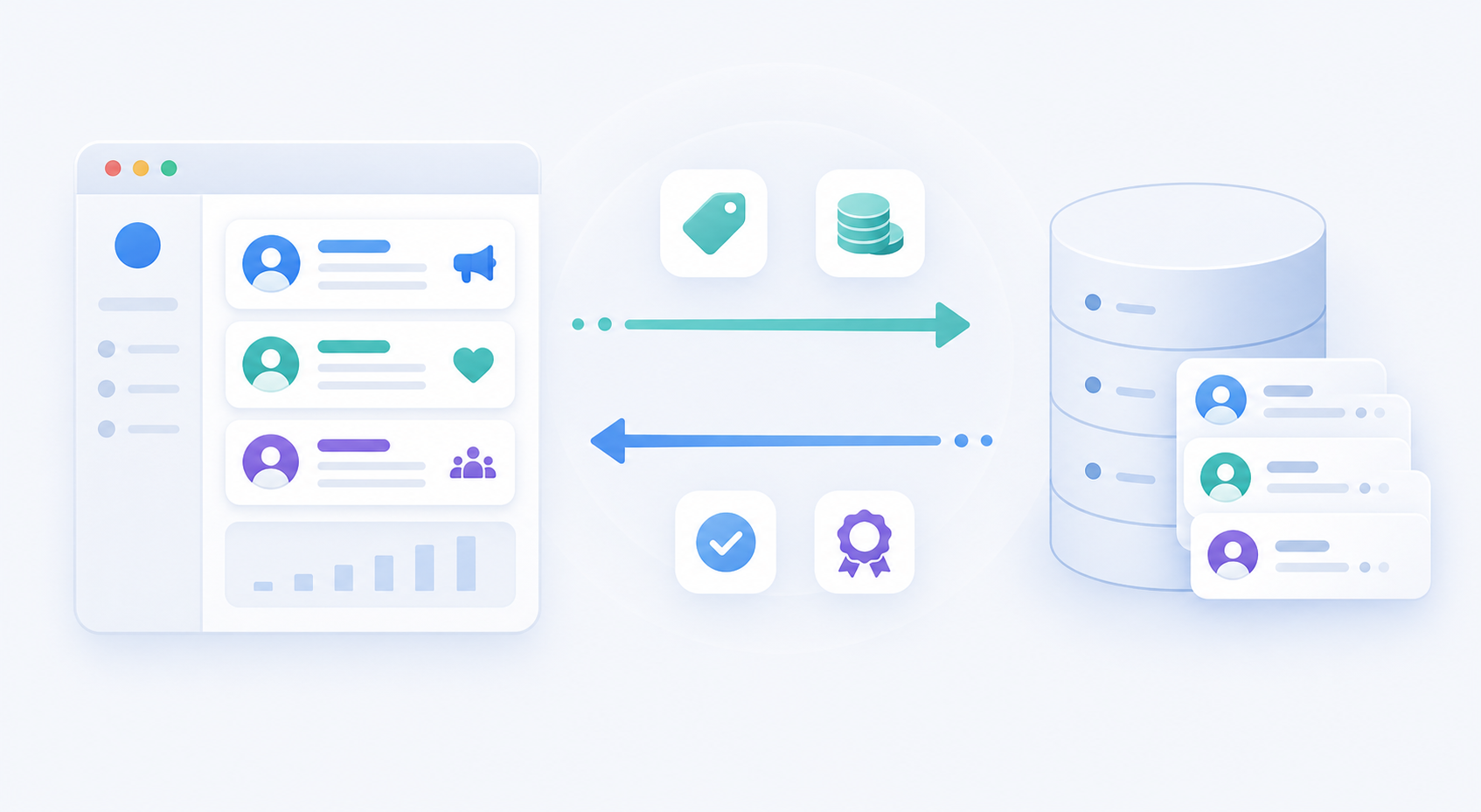
Inbound sync seeds your tool. When a campaign starts, organizers need existing supporter records pulled from Salesforce or HubSpot so they're not building lists from scratch: names, emails, phone numbers, geographic data, and any existing tags or segment memberships.
Outbound sync is where value compounds. After a supporter takes an action, that activity has to write back to the CRM:
- Action history and timestamps tied to specific campaigns
- Tags applied during the campaign lifecycle
- Opt-in and consent status for compliance purposes
- Donation amounts and recurrence flags
- Engagement scores or activity counts
Get these wrong and CRM automations break. Triggers built on "has taken action" never fire. Segments based on donation history go stale.
Sync cadence depends on campaign cycles. During an active call-to-action window, near-real-time or hourly syncs matter. Between campaigns, nightly or weekly works fine. The architecture has to support both without requiring manual intervention from advocacy staff.
Deduplication sits at the center of all of this. The same supporter often exists in the CRM under slightly different email formats or with a merged record from a previous migration. Any sync layer needs a matching strategy before it writes, or you create more chaos than you resolve.
The Contact Deduplication Problem in Donor and Supporter Databases
Duplicate records are quietly one of the most damaging problems in advocacy tech, and they almost never get budgeted for during an integration scoping conversation. They're one of the hidden line items in maintaining integrations long-term.
The pattern is predictable. A supporter donates through one tool, signs a petition through another, and attends a local event that gets logged separately. By the time your app syncs contacts into their CRM, three records exist for the same person. As Media Cause notes, when Salesforce is used incorrectly, it becomes an expensive source of potential disinformation and causes severe misalignment across departments. For advocacy orgs, that misalignment means campaign managers send duplicate emails, segment counts inflate, and donor history fragments across ghost records.
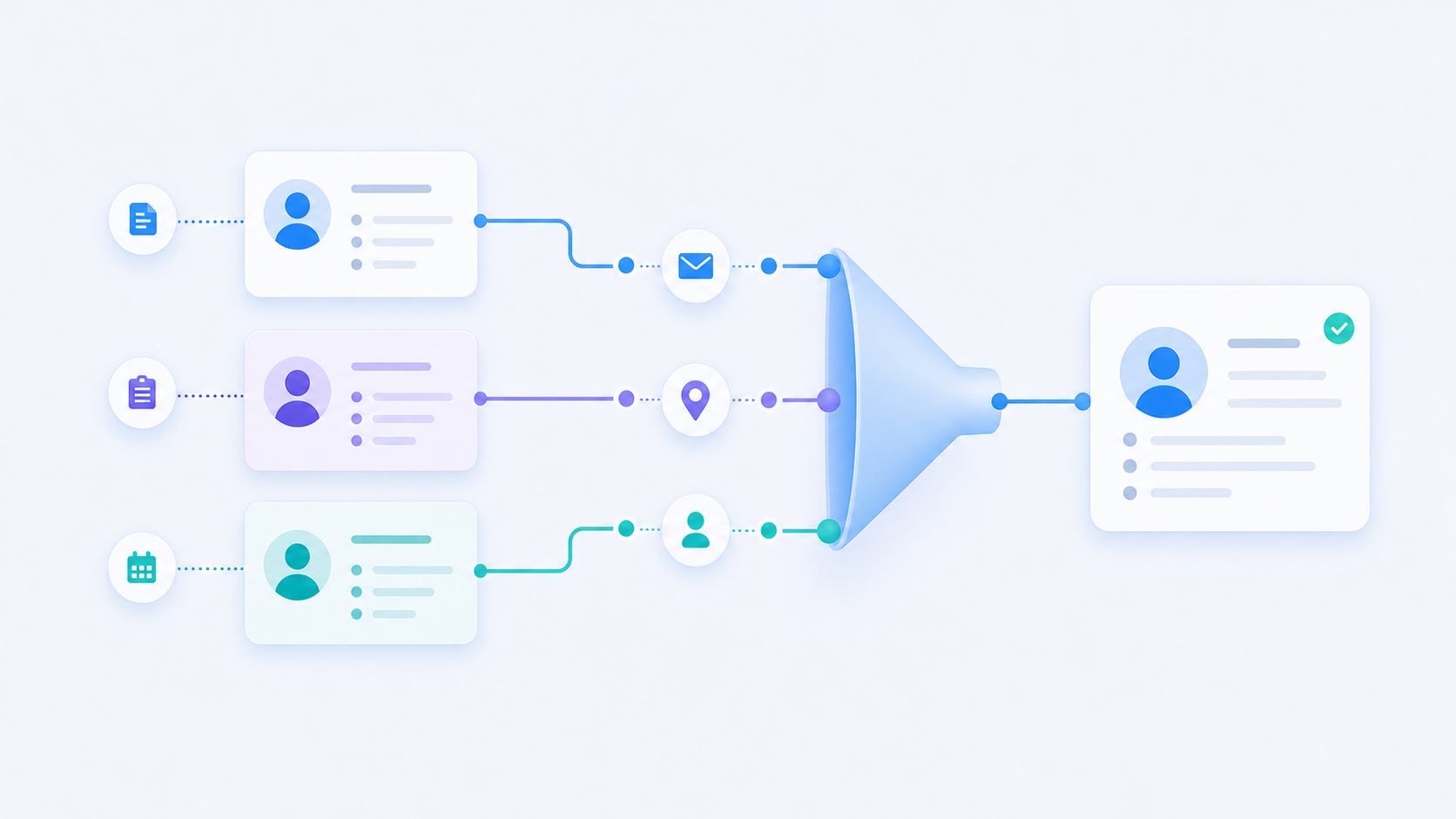
A naive sync that writes without checking first makes this worse. The fix is matching logic that runs before any write operation:
- Match on email as the primary key
- Fall back to name plus postal code when email differs slightly
- Flag ambiguous matches for manual review instead of auto-merging
Hotglue's record-matching engine supports multi-field deduplication out of the box, matching on email, postal location, or field combinations to determine whether to update or create a record.
Field Mapping for Advocacy-Specific Data
Advocacy platforms carry fields that CRMs were never designed to hold. Campaign tags, action types, engagement scores, advocacy action counts, donation tier labels: none of these have a standard home in a Salesforce Contact or HubSpot Contact record. So you either map them into custom fields, squeeze them into notes, or lose the data entirely.
Most in-house builds get stuck here. The initial sync works fine for name, email, and phone. Then a campaign manager asks why their "High Value Advocate" tier label isn't showing up in Salesforce, and suddenly someone is writing custom transformation logic to flatten nested action arrays into a string a CRM field can hold.
The transformation layer between source schema and destination schema needs to handle:
- Custom field creation or mapping to existing CRM custom fields
- Type coercion (action counts as integers, engagement scores as decimals)
- Array-to-string flattening for multi-value tag fields
- Conditional logic (only write donation tier if amount exceeds threshold)
Hotglue's Python-powered transformation layer handles exactly this kind of mapping, following the same approach outlined in custom mapping for CRM integrations. You write the logic once per connector pair, and it runs on every sync without touching your core product code.
Sync Scheduling for Campaign and Fundraising Cycles
Advocacy campaigns don't run on a steady drumbeat. A bill drops in committee and your organizers need supporter contact data refreshed in the next hour, not overnight. That urgency is completely different from a typical B2B SaaS scenario where nightly syncs cover most use cases.
Cadence decisions break down by campaign phase:
CRM Sync Cadence by Campaign Phase
| Campaign Phase | Recommended Cadence | Purpose |
|---|---|---|
| Active legislative window or fundraising sprint | Hourly or near-real-time | Organizers work with current supporter data when every hour counts |
| Ongoing constituent relationship maintenance | Nightly | Covers the baseline without over-taxing connected CRMs |
| Post-campaign cleanup and tag reconciliation | Weekly or on-demand | Handles housekeeping after a push ends |
| Pre-rally or matched-giving deadline | Manual on-demand trigger | Lets advocacy staff force a refresh without filing a support ticket |
Hotglue supports flexible cron-based scheduling configurable per connector, so you can run your Salesforce connector inbound sync hourly during a campaign while keeping your HubSpot outbound write on a nightly schedule in the same deployment. When a campaign manager needs to force a refresh before a major call-to-action push, the manual on-demand trigger handles it without touching scheduled cadences.
That on-demand case matters more than it sounds. Advocacy staff aren't engineers. They need a way to trigger a sync before a rally or a matched-giving deadline without filing a support ticket.
Embedding the Integration Experience for End Users
The end user connecting a CRM to your advocacy tool is usually a campaign director or development associate, not a developer. They shouldn't need to file a ticket with their IT department to get Salesforce talking to your product.
Two deployment patterns handle this cleanly:
- An embedded widget that lives inside your product's settings or onboarding flow, where the user authenticates with their CRM directly inside your app without ever leaving it.
- A Magic Link, a branded URL you send to the user that opens a standalone connection flow entirely outside your product, requiring no engineering work from the partner's side.
The practical difference comes down to your customers' technical capacity. Civic tech orgs, particularly smaller nonprofits and advocacy groups, often have no in-house engineers at all. A Magic Link flow means your customer success team can send a link over email and the organizer handles authentication in a few clicks.
Hotglue supports both patterns. The embedded widget works for teams with the engineering capacity to drop in a component. Magic Links cover the rest, which in the nonprofit and advocacy space is a sizeable portion of your user base.
OAuth and Authentication for CRM Connectors
OAuth with Salesforce or the HubSpot connector sounds routine until a token refresh silently fails during a campaign window and your organizers are staring at stale data with no error message.
Building auth in-house means owning the full surface: app registration in each CRM's developer console, managing client credentials securely, implementing token refresh cycles before expiry, handling scope changes when CRM vendors update their permission models, and meeting requirements like PKCE, which Salesforce now mandates for external client apps. Miss one rotation cycle and the integration breaks for every tenant using that CRM.
Hotglue handles the OAuth layer per connector, including PKCE for Salesforce, so your engineering team configures auth once and avoids rebuilding it each time a CRM updates its requirements.
Handling Integration Failures Without Burning Supporters
When a sync fails mid-run and half your donor records updated while the other half didn't, the damage spreads fast. Campaign managers call supporters with wrong contact info, fundraising calls go to disconnected numbers, and email sequences fire against stale segment data.
Partial write failures are the worst case. A job that silently succeeds on 800 of 1,000 records leaves your advocacy org with no idea which 200 didn't update. Without atomic guarantees, there's no clean way to retry without risking duplicate writes on records that already processed.
Hotglue guarantees a partial sync failure never silently succeeds, a reliability bar any team looking to offer a native CRM integration should hold itself to. It either delivers all data or fails the job and preserves state for retry. That gives your customer success team a clear signal: this job failed, here's which tenant, here's where it stopped.
That visibility matters as much as the failure handling itself. Your CS team shouldn't hear about a broken sync from an organizer who noticed stale donor data the morning of a fundraising push. Job health monitoring across tenants surfaces affected customers before they file a ticket.
The retry path also has to be safe. Hotglue's state preservation means a retried job picks up without re-processing records that already wrote successfully, so your deduplication logic doesn't fight against its own previous run.
How hotglue Powers Embedded Contact Sync for Civic Tech SaaS
Hotglue ships connectors for Salesforce (with PKCE), HubSpot, NewMode, and Qomon. The NewMode connector syncs contacts from unified sources directly into NewMode campaigns, which is exactly the use case advocacy SaaS teams keep running into. The Qomon connector syncs contacts, tags, and custom fields, covering the organizing-focused end of the civic tech stack.
Both sync directions work. Inbound pulls existing supporter records from your customers' CRMs before a campaign starts. Outbound writes action history, tags, opt-in status, and engagement data back after supporters act. A multi-field record-matching engine runs deduplication before any write, matching on email, postal location, or field combinations to keep CRM records clean.
Field mapping for advocacy-specific data runs through Hotglue's Python transformation layer. When a campaign tag needs to map to a custom Salesforce field or a donation tier label needs type coercion before writing to HubSpot, the logic lives in a transformation script that runs on every sync without touching your product code. GluestickAI generates that Python from a plain-language description, cutting mapping work from days to hours. It's part of the broader playbook for adding customer-facing CRM integrations to a SaaS product.
Non-technical advocacy staff get Magic Links for self-serve setup. Cron-based scheduling handles campaign timing. The infrastructure underneath processes roughly 10 billion records weekly across 38,000+ active tenants, so the system scales as your customer base grows.
Final Thoughts on CRM Sync and Contact Management for Civic Tech SaaS
For advocacy orgs, bad sync goes beyond a support ticket. It breaks relationships with real supporters at the worst possible time. Getting the data model right, handling deduplication before writes, and matching sync cadence to campaign cycles are all things your team can build, but the maintenance bill grows fast and fast-growing integration debt is nobody's idea of a good time. Hotglue gives CPOs and product leads a genuinely better answer: pre-built connectors for Salesforce, HubSpot, NewMode, and Qomon; bidirectional sync with multi-field deduplication baked in; a Python transformation layer for advocacy-specific field mapping; Magic Links for non-technical end users; and infrastructure that processes 10 billion records weekly across 38,000+ tenants. It's the kind of embedded integration platform that lets your engineers focus on the product work that actually sets you apart, not on debugging token refresh cycles the night before a fundraising deadline. Book a demo with hotglue to see what that looks like in practice.
FAQ
How do I connect my advocacy SaaS product to Salesforce and HubSpot without my engineering team rebuilding each CRM connector from scratch?
Embed an integration layer like Hotglue that ships pre-built connectors for Salesforce (including PKCE auth) and HubSpot, so your team configures and deploys instead of building from zero. Each new CRM request (EveryAction, a legacy nonprofit CRM, whatever comes next) follows the same pattern without touching your core product code. Hotglue can stand up a new connector in one to two weeks from API access.
What is the build-vs-buy case for native CRM integrations in civic tech SaaS?
Building in-house sounds like two weeks of work but routinely runs to $50,000 to $200,000 per connector and three to six months before you even start on maintenance: OAuth token rotation, schema drift when HubSpot adds a field, Salesforce API version deprecations. For advocacy platforms where supporters expect action history, opt-in status, and donation data to flow back into CRM segments reliably, that maintenance surface compounds fast. An embedded integration layer moves your team from rebuilding connectors to configuring them.
How does contact deduplication work when syncing supporter records between an advocacy platform and a CRM like Salesforce?
Match on email as the primary key first, then fall back to name plus postal code when email formats differ, and flag ambiguous matches for manual review instead of auto-merging. Hotglue's record-matching engine runs multi-field deduplication before any write operation, matching on email, postal location, or field combinations, so a supporter who donated through one tool and signed a petition through another doesn't generate three ghost records in Salesforce.
NewMode integration vs. building a custom advocacy platform CRM sync: which approach makes sense for a civic tech SaaS team?
NewMode's existing EveryAction integration shows what custom-built looks like: one connector, one CRM, owned and maintained by your team. If your customers use Salesforce, HubSpot, or any CRM outside that connector, you're back to a build from scratch. Hotglue's NewMode connector syncs contacts from unified sources directly into NewMode campaigns alongside Qomon (contacts, tags, custom fields), with both inbound and outbound sync directions covered, giving advocacy SaaS teams a repeatable architecture instead of a one-off build per CRM request.
How should sync scheduling be set up for advocacy campaigns that spike during active legislative windows or fundraising sprints?
Run hourly or near-real-time syncs during active campaign phases, nightly for baseline constituent relationship maintenance, and on-demand for one-off refreshes before a rally or matched-giving deadline. Hotglue supports cron-based scheduling configurable per connector, so your Salesforce inbound sync can run hourly while your HubSpot outbound write stays on a nightly cadence in the same deployment. Advocacy staff can also trigger a manual refresh without filing a support ticket.